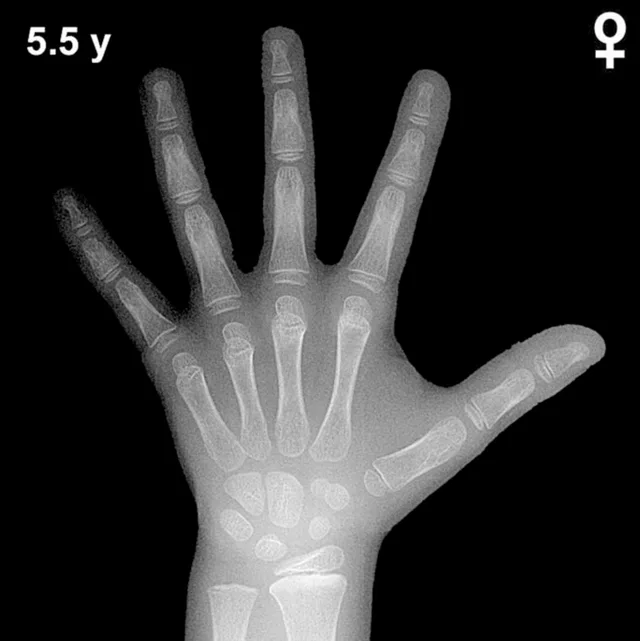
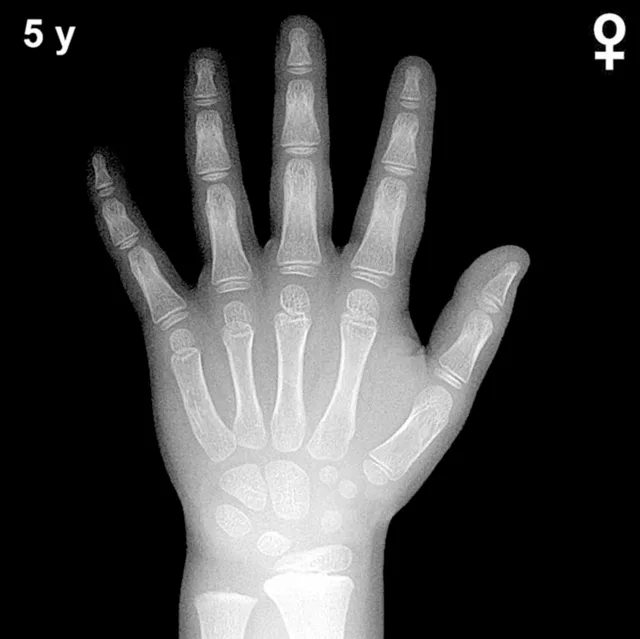
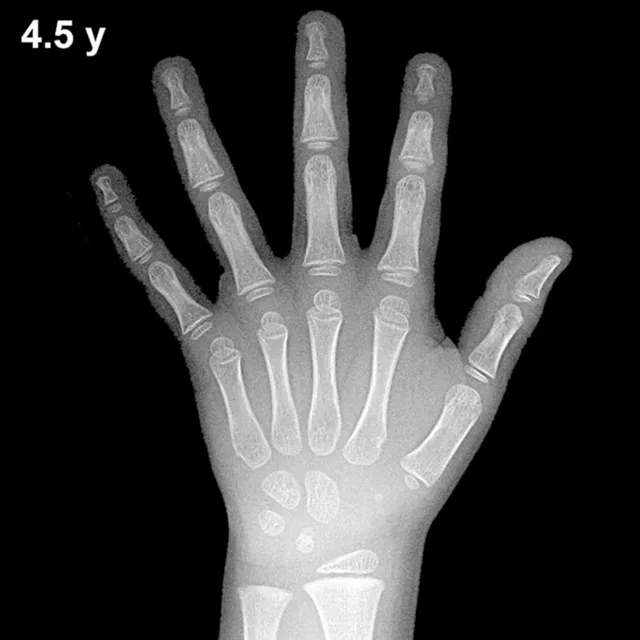
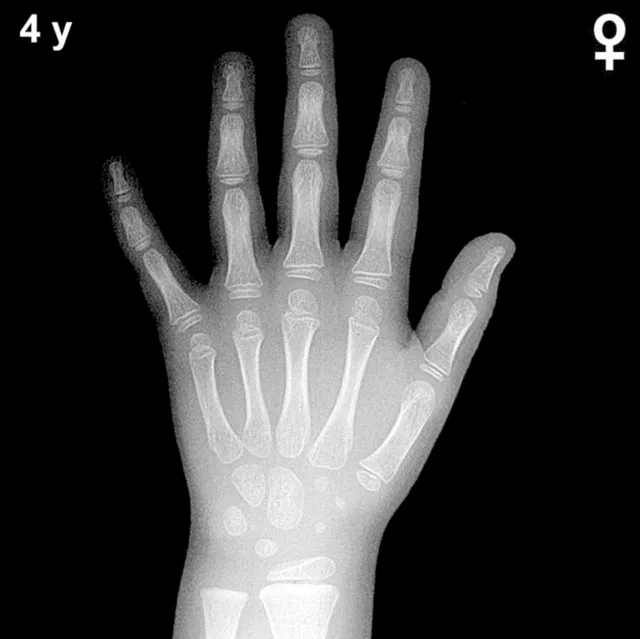
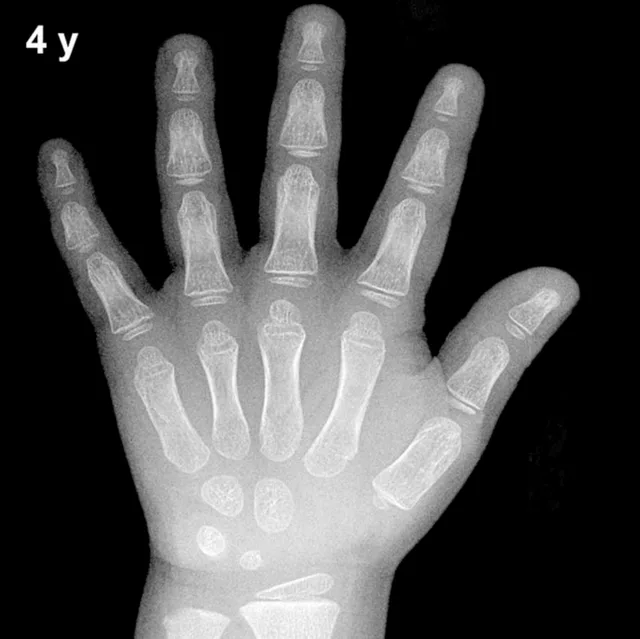
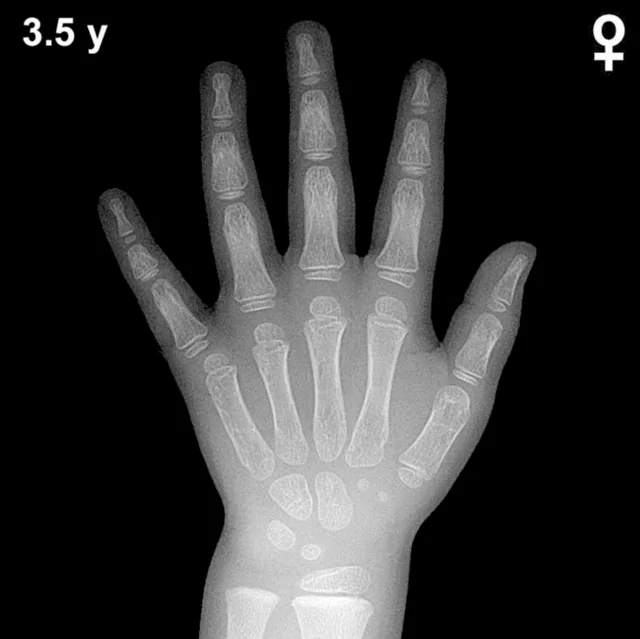
Bone Age in Girls Aged 4.5 Years — Greulich-Pyle Hand and Wrist X-Ray Reference
Bone age assessment using a left hand and wrist radiograph is a standard method for evaluating skeletal maturity in children. The Greulich-Pyle atlas provides sex-specific standard radiographs against which a child's film is compared to determine whether skeletal development is appropriate, advanced, or delayed for chronological age. In girls aged 4.5 years, this assessment is particularly relevant in the workup of precocious puberty, growth hormone deficiency, hypothyroidism, and other endocrine or systemic disorders affecting growth.
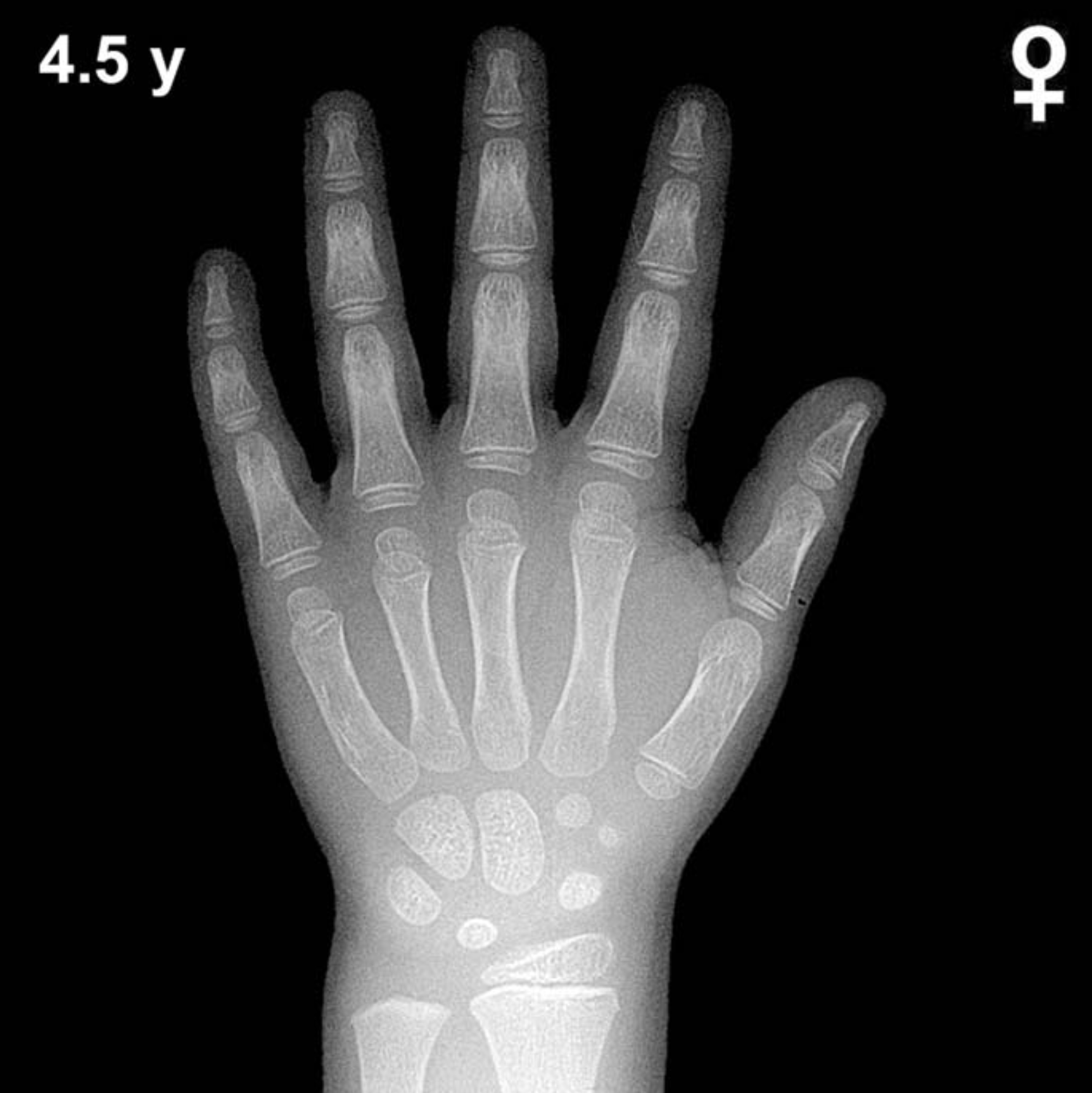
Expected Ossification Centers and Skeletal Findings
By 4.5 years of age in girls, all eight carpal bones are typically beginning to ossify or are already visible. The capitate and hamate are among the earliest to appear (by approximately 3–6 months of age) and are well established at this age. The triquetral ossification center generally appears between 2–3 years, and the lunate between 3–4 years; both should be visible by 4.5 years in most girls. The scaphoid, trapezium, and trapezoid ossification centers typically emerge between 4–6 years, and may be present or just emerging at this age.
The distal radial epiphysis is well ossified by this age, having typically appeared around 1 year. The distal ulnar epiphysis generally appears between 5–7 years and may not yet be visible at 4.5 years in girls. Metacarpal and phalangeal epiphyses are present and maturing. The pisiform and the thumb sesamoid are not expected at this age; the pisiform typically appears around 9–12 years in girls and the sesamoid emerges in the peripubertal period.
- Well established: Capitate, hamate, triquetral, lunate, distal radial epiphysis
- Emerging or present: Scaphoid, trapezium, trapezoid
- Not yet expected: Pisiform, thumb sesamoid, distal ulnar epiphysis (may be absent)
Clinical Pearls
Girls skeletal maturation is typically 1–2 years ahead of boys at comparable chronological ages, a difference reflected throughout the Greulich-Pyle standards. At 4.5 years, a bone age significantly advanced beyond this level may suggest precocious puberty or exogenous androgen/estrogen exposure, while a notably delayed bone age raises concern for growth hormone deficiency, hypothyroidism, or constitutional delay of growth and puberty. Bone age in healthy children carries an inherent variability of approximately ±1 standard deviation (roughly 6–12 months at this age), so isolated mild discrepancies should be interpreted in the full clinical context. A key pitfall is over-relying on a single carpal center's appearance; assessment should integrate multiple ossification centers and epiphyseal morphology for accuracy. Reference: Greulich WW, Pyle SI. Radiographic Atlas of Skeletal Development of the Hand and Wrist. 2nd ed. Stanford University Press, 1959.