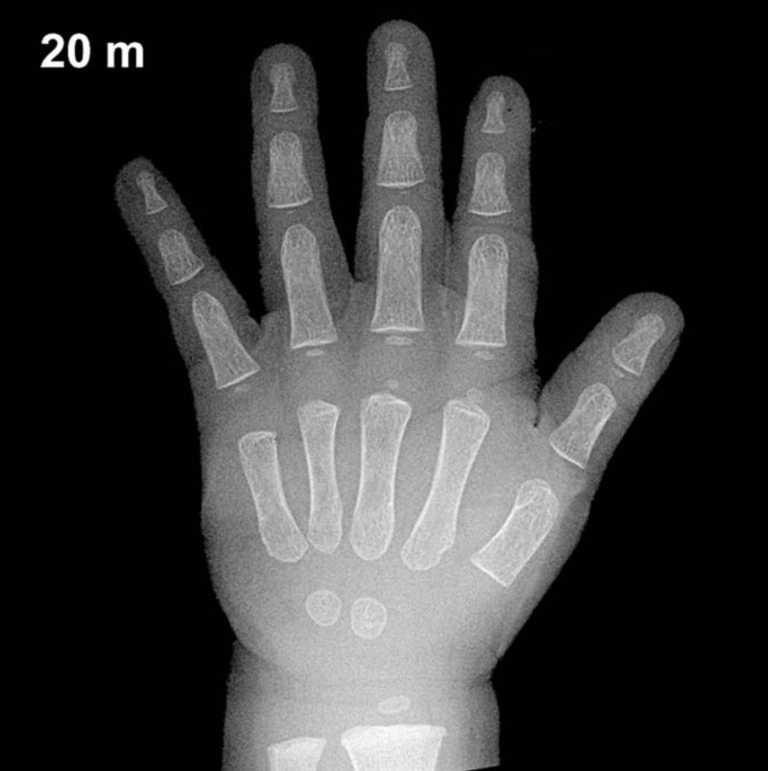
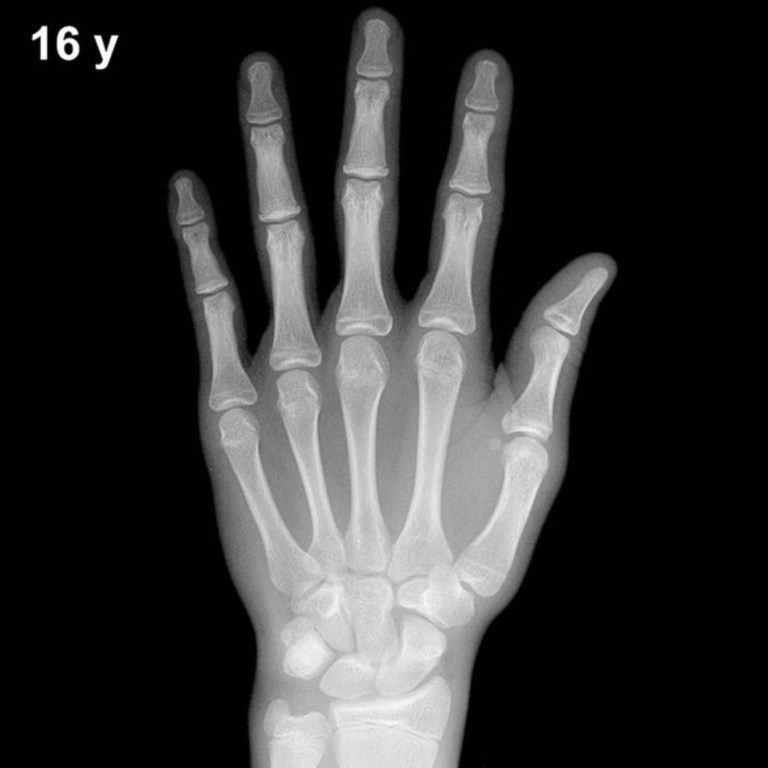
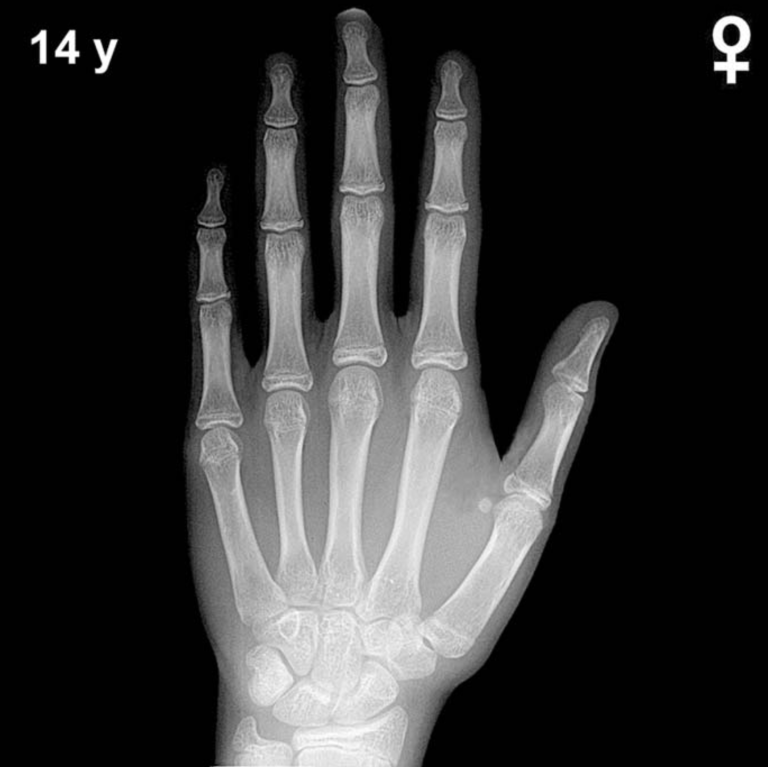
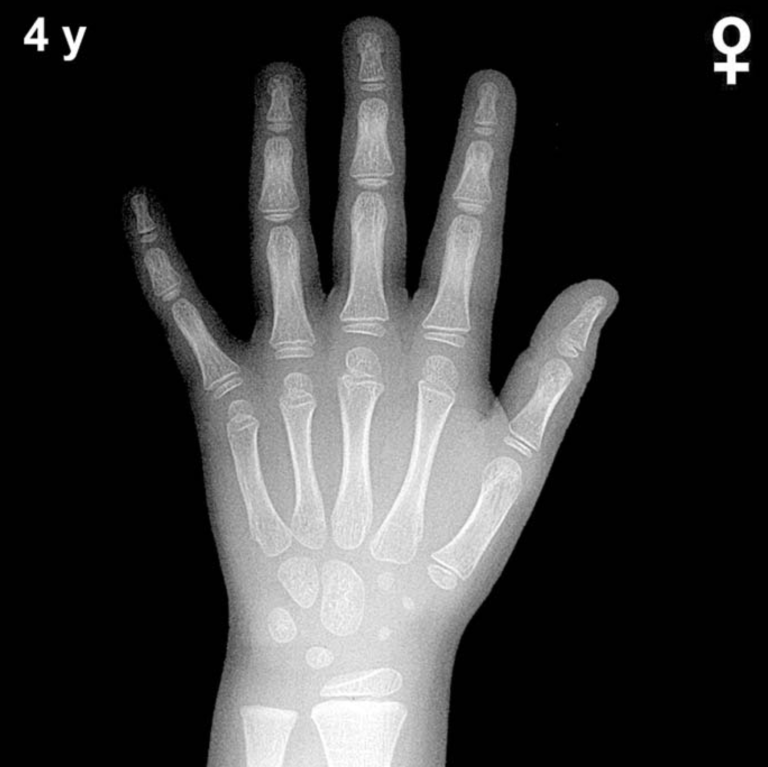
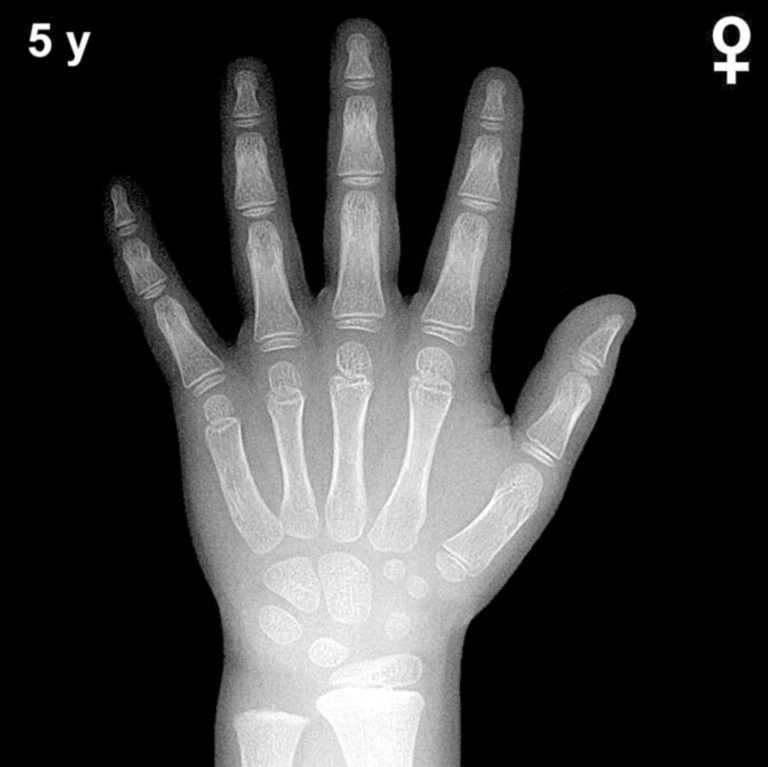
Bone Age in Boys Aged 4.5 Years — Greulich-Pyle Hand and Wrist X-Ray Reference
Bone age assessment using a left hand and wrist radiograph is a cornerstone of pediatric endocrine and growth evaluation, allowing clinicians to compare a child’s skeletal maturity against population standards. The Greulich-Pyle method matches the radiograph to the closest standard plate in the atlas, providing an estimate of skeletal age that may differ from chronological age. In boys aged 4.5 years, this assessment is particularly relevant in the workup of short stature, growth hormone deficiency, precocious puberty, and constitutional growth delay.
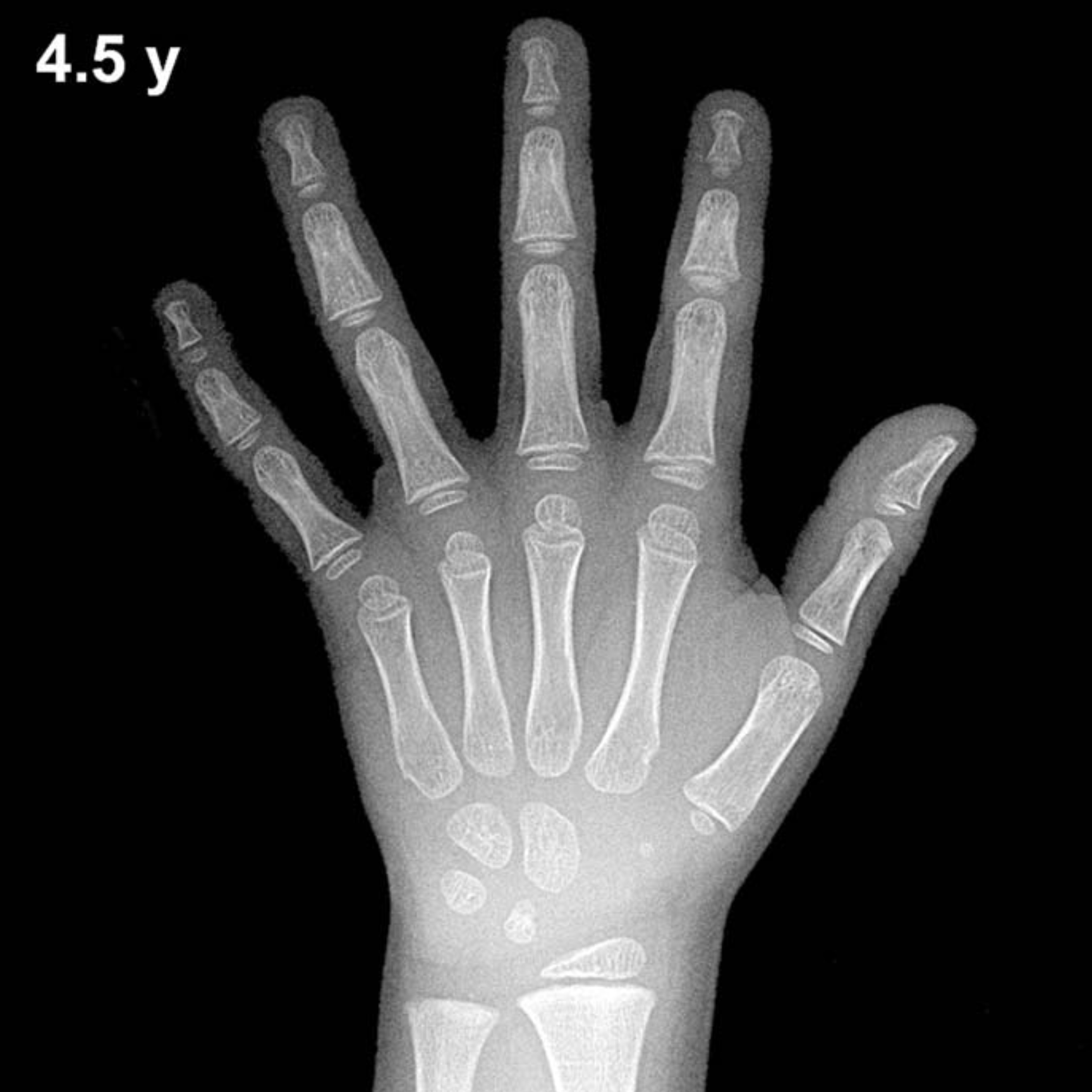
Expected Ossification Centers and Skeletal Findings
By 4.5 years of age in boys, several carpal and epiphyseal ossification centers are typically well established. The capitate (appearing ~3 months) and hamate (~6 months) are long visible and should be well ossified. The triquetral ossification center, which typically appears between 2–3 years in boys, is expected to be present. The lunate, appearing around 3–4 years, should be visible or just emerging at this age.
The distal radial epiphysis, which ossifies around 1 year of age, is well established by this stage and shows progressive definition. Epiphyses of the metacarpals and proximal, middle, and distal phalanges should all be visible and show ongoing maturation in size and contour. The scaphoid, trapezium, and trapezoid typically begin ossifying between 4–6 years; at 4.5 years in boys, these centers may be just appearing or still absent, and their presence or absence is an important maturity indicator.
- Capitate & hamate: Well ossified
- Triquetral: Present
- Lunate: Present or newly visible
- Distal radial epiphysis: Well established
- Scaphoid, trapezium, trapezoid: May be absent or just appearing
- Pisiform: Not expected (typically 11–14 years in boys)
- Distal ulnar epiphysis: Not expected until ~5–7 years
Clinical Pearls
Skeletal maturation in girls is consistently ahead of boys; at 4.5 chronological years, a girl’s bone age standard would show more advanced carpal ossification than the equivalent boy’s standard. A bone age advanced by ≥2 standard deviations in a 4.5-year-old boy should prompt evaluation for precocious puberty, congenital adrenal hyperplasia, or exogenous androgen exposure. Conversely, a delayed bone age raises concern for growth hormone deficiency, hypothyroidism, or constitutional delay of growth and puberty. Normal variation is approximately ±1 year (roughly ±1 SD) at this age. A key pitfall is over-reliance on a single carpal center — interpretation should integrate the overall pattern of all visible epiphyses and carpals rather than any one ossification center in isolation. Reference: Greulich WW, Pyle SI. Radiographic Atlas of Skeletal Development of the Hand and Wrist. 2nd ed. Stanford University Press, 1959.