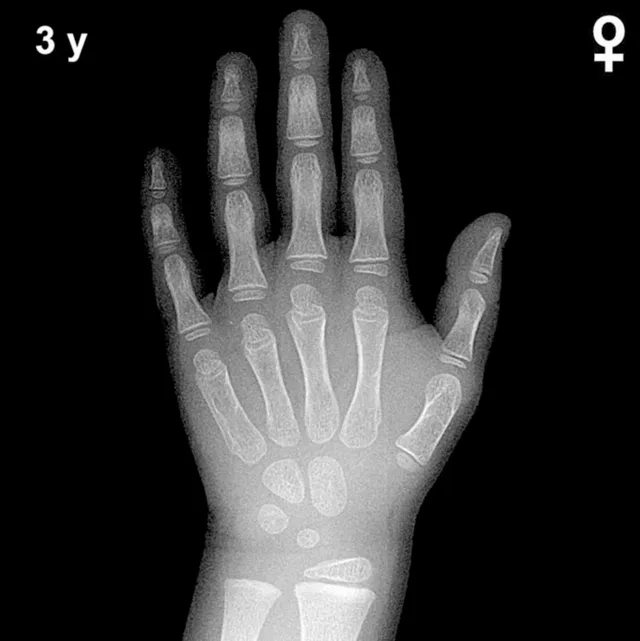
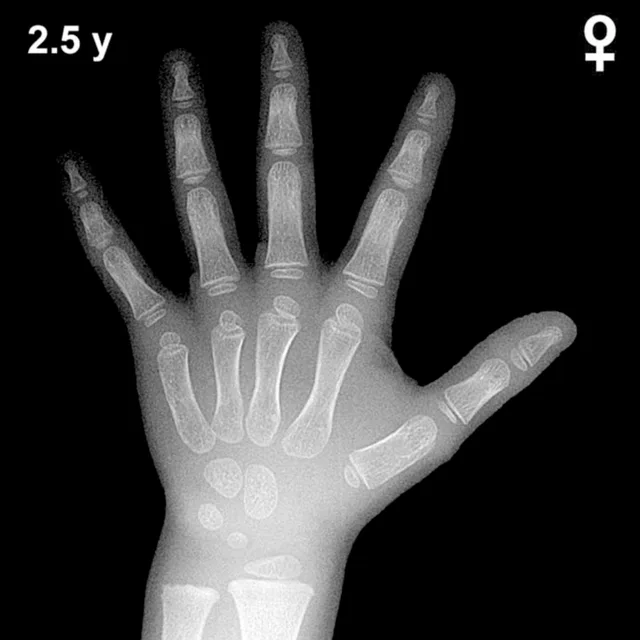
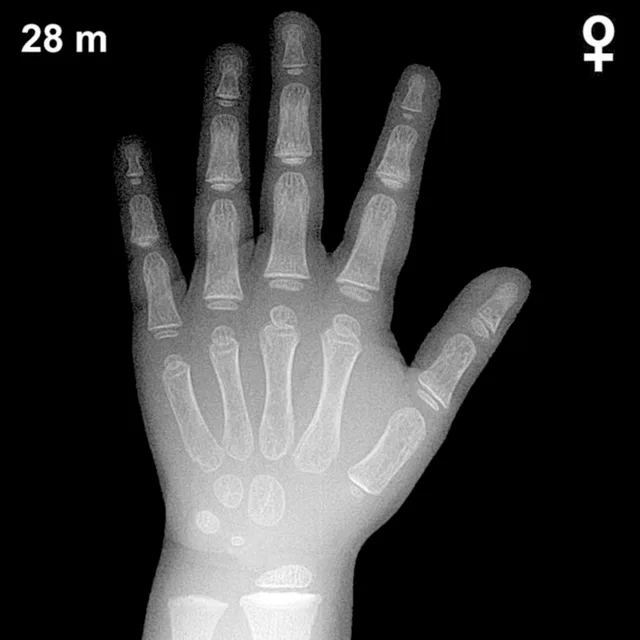
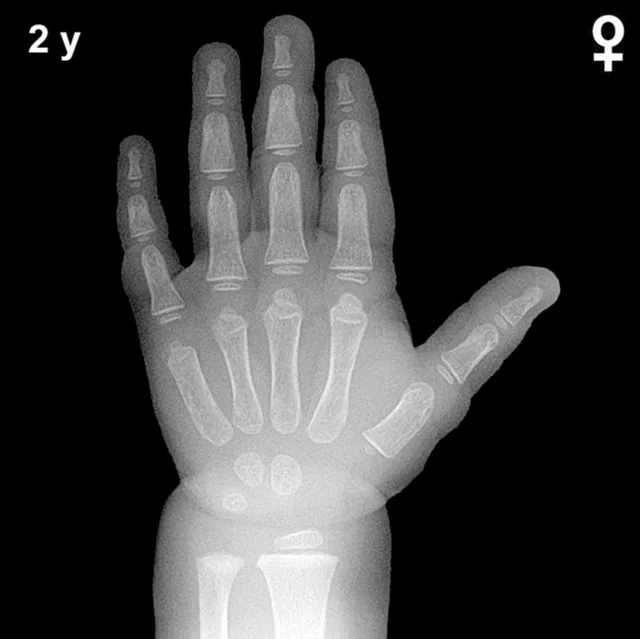
Bone Age in Girls Aged 18 Months — Greulich-Pyle Hand and Wrist X-Ray Reference
Bone age assessment uses a left-hand and wrist radiograph to estimate skeletal maturity, most commonly interpreted against the Greulich-Pyle atlas standards. In toddlers, this evaluation is particularly relevant when investigating failure to thrive, short stature, or suspected endocrine disorders such as hypothyroidism or growth hormone deficiency. Comparing skeletal age to chronological age helps clinicians determine whether a child's growth trajectory is appropriate for her age.
Expected Ossification Centers and Skeletal Findings
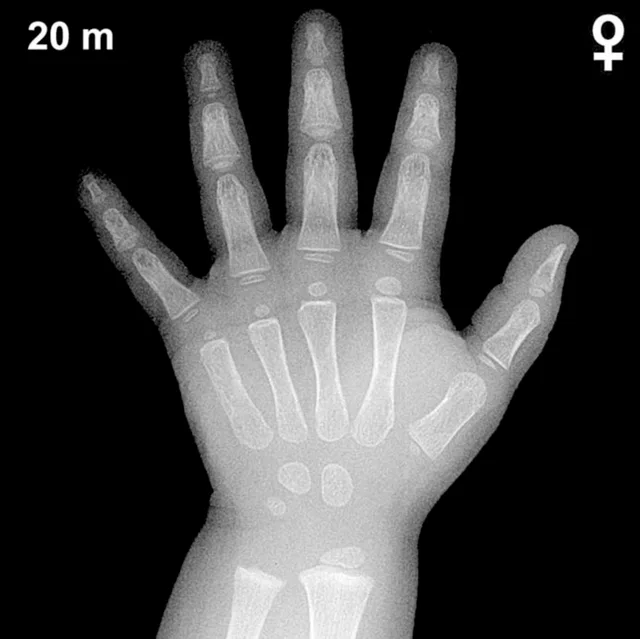
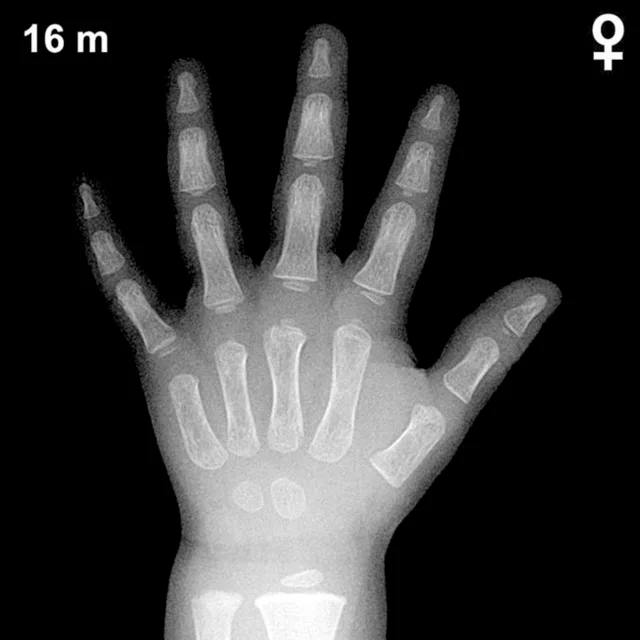
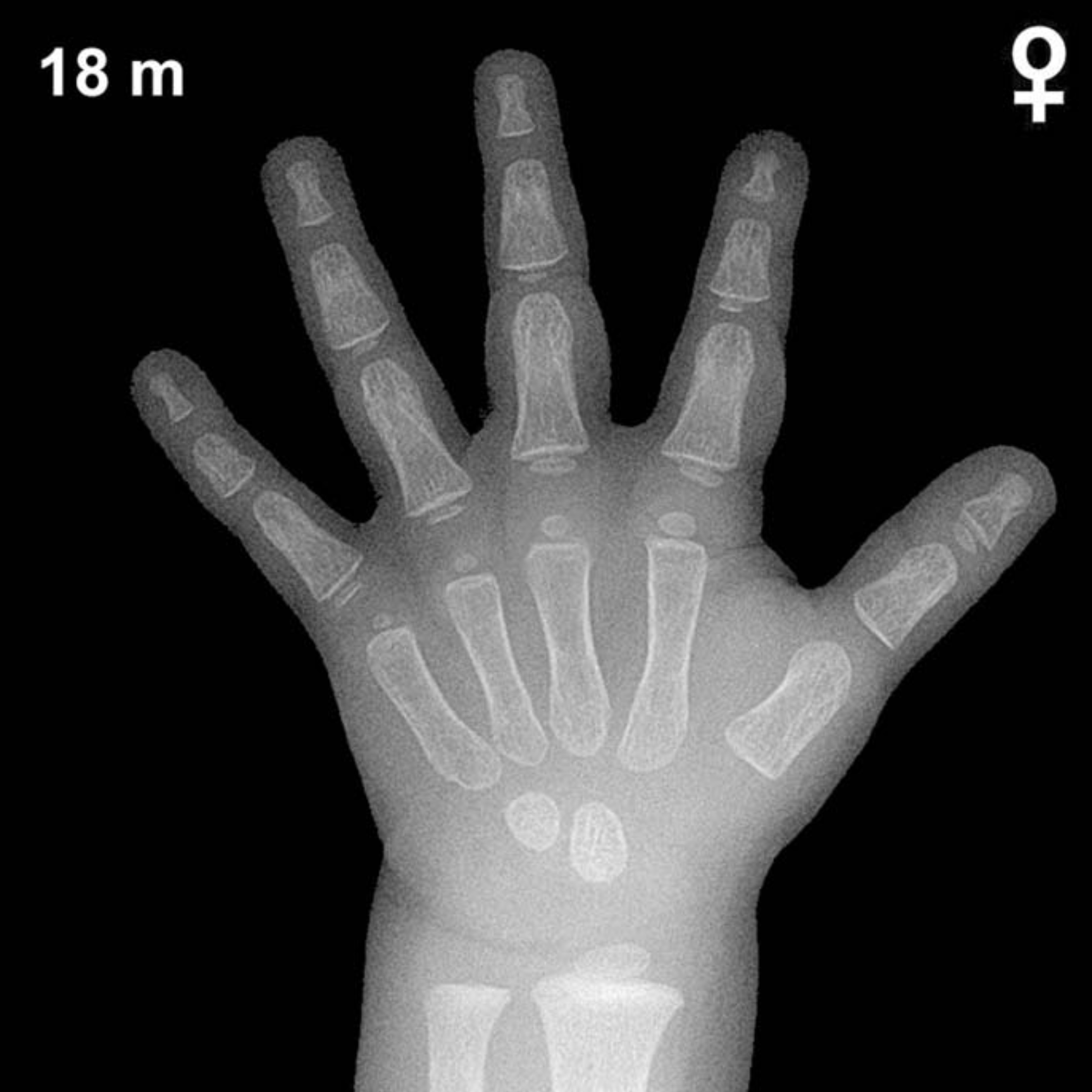
At 18 months in girls, the hand and wrist radiograph is characterized by a limited but predictable set of ossification centers. The capitate and hamate are the earliest carpal bones to appear, typically ossifying by approximately 3 and 6 months of age respectively, and should be well established by 18 months. The triquetral ossification center typically emerges between 2 and 3 years in girls, so its presence at 18 months would suggest skeletal advancement, while its absence is entirely normal at this age.
The distal radial epiphysis typically appears around 12 months of age and should be visible and developing by 18 months in girls. The remaining carpal bones — lunate, scaphoid, trapezium, trapezoid, and pisiform — are not expected to be ossified at this age. The metacarpal and phalangeal epiphyses are beginning to appear but remain small and rounded. The distal ulnar epiphysis is generally not yet visible at 18 months, as it typically ossifies between 5 and 7 years of age.
- Capitate: present (ossifies ~3 months)
- Hamate: present (ossifies ~6 months)
- Distal radial epiphysis: typically present (ossifies ~12 months)
- Triquetral: not yet expected (typically 2–3 years in girls)
- Lunate, scaphoid, trapezium, trapezoid, pisiform: absent at this age
Clinical Pearls
Skeletal maturation in girls is consistently ahead of boys by approximately 1–2 months at this early age, a gap that widens significantly during mid-childhood and puberty. At 18 months, a normal bone age carries a standard deviation of roughly ±3–4 months. A bone age significantly advanced beyond 18 months may prompt evaluation for precocious puberty or exogenous androgen/estrogen exposure, while a notably delayed bone age raises concern for hypothyroidism, growth hormone deficiency, or constitutional delay of growth.
A key interpretive pitfall at this age is over-reliance on a single ossification center: the appearance or absence of the triquetral alone should not be used to assign skeletal age without assessing the overall maturation pattern of all visible epiphyses and carpals together. Reference: Greulich WW, Pyle SI. Radiographic Atlas of Skeletal Development of the Hand and Wrist. 2nd ed. Stanford University Press, 1959.